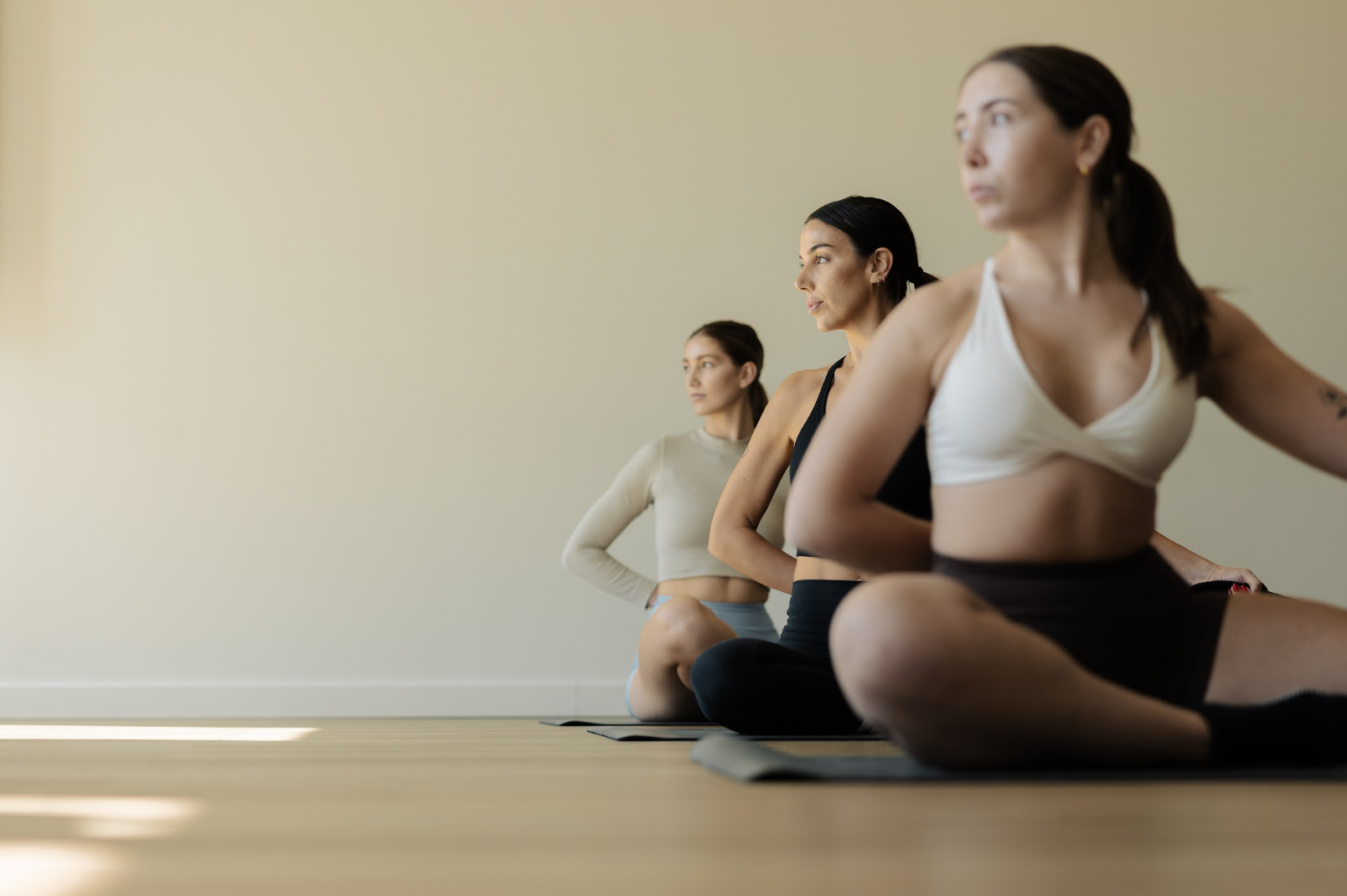
The Benefits of Exercise on Mental Health and Stress
At FS8, mental health is one of our eight pillars – we believe physical activity and mental wellbeing are intrinsically linked, and this philosophy shows up in all our workouts.
Regular movement has been shown to support mood, ease stress, build confidence, improve sleep, and even strengthen emotional resilience – making it one of the most accessible tools we have for looking after our minds, as well as our bodies. Exercise isn’t a cure-all, and it’s by no means a substitute for professional mental health support, but it can make a real difference in how you think, feel, and show up each day.
Read on to learn more about the benefits of exercise for mental health, why it’s something we stand for, and how our blend of Pilates, tone, and yoga-inspired movement helps bring that belief into every class.
How does exercise support mental health?
Using exercise for mental health can have both immediate and long-term effects on your brain. The moment you start moving, your heart rate rises and sends more oxygen and nutrients to the areas of your brain that regulate mood and focus – which is why even a simple stretch at your desk can leave you feeling better in minutes.
Keep training consistently over the following weeks, and your brain starts producing more BDNF (Brain-Derived Neurotrophic Factor). It’s a protein that acts like fertilizer for your brain cells: helping them adapt, form new connections, and become more resilient under stress1.
7 mental benefits of exercise
We all know exercise is “good for you”: it builds muscle and strengthens your heart, to only name a few! But some of its most meaningful effects are the ones you can’t see. Below, we explore seven benefits of exercise on mental health – and how regular movement can support the way you feel every day.
1. Exercise can support mood
Exercise releases feel-good hormones such as endorphins and serotonin, which help ease stress and lift your mood2. Your brain releases even more of these hormones when you complete something challenging, so the satisfaction of finishing a workout is chemically reinforcing that mood boost long after you’ve left the studio.
Our tip? Try booking an early class – that exercise and mood lift will set you up for the whole day. Start a trial at your closest FS8 studio and find a morning class near you.
2. Exercise can improve confidence
Another mental benefit of exercise is confidence – and how it works in your brain isn’t always about appearance (although that tends to follow too).
As Pilates builds strength and tones your body, it’s also helping you build the physical skill to move with control and ease. That growing sense of capability carries over mentally, helping you feel more assured and resilient in your daily decisions.
3. Exercise can support sleep
Sleep is crucial for mental health, and you need to be getting at least seven hours of it a night.3 But when your circadian rhythm – your body’s internal 24-hour clock that guides your sleep and wake cycle – gets thrown off by stress, screen time, or a racing mind, a good night’s sleep can be hard to come by. Gentle movement helps calm your nervous system, which is why yoga for sleep has become such a popular wind-down ritual.
At FS8, yoga-inspired movement runs through every class, especially as we cool down – easing your nervous system out of “go” mode so you leave feeling settled and ready to switch off when it’s time for bed.
4. Exercise can support focus and mental clarity
The mental benefits of exercise include sharper cognitive function – the complex brain activity behind problem-solving, memory, attention, and processing speed. A natural part of getting older means that these functions deteriorate, which can be stressful in itself. However, regular and consistent physical exercise can help prevent or lessen cognitive decline and may even diminish the risk of developing dementia4.
This is part of why Pilates for over 60s is so effective – the coordination and controlled sequencing involved actively engages your mind. To build on this, try ending a class by mentally naming three things you focused on: a small habit that strengthens the mind-body connection Pilates builds.
5. Exercise can create routine and structure
Routine plays a powerful role in your mental wellbeing – it creates consistency, builds momentum, and gives you a sense of control, especially during chaotic or uncertain periods. Rather than relying on motivation to work out, which naturally rises and falls, a set regimen takes the stressful decision-making out of the equation.
If routine is something you struggle with, try locking in the same class times each week – even if it’s just one – to schedule movement into your week, rather than leaving it to chance. The FS8 app makes this effortless – letting you book classes, check your instructor, and get reminders so you never miss your next session.
6. Exercise can support social connection
There are so many benefits to group exercise, and mental health is a big one – sharing the effort with others builds a sense of belonging and eases feelings of isolation5. It’s also a refreshingly low-pressure way to meet and connect with new people. (The small talk is easy when you’ve got a shared enemy in the form of your fourth round of pulses!)
At FS8, our instructor-led classes give everyone a shared experience worth returning for, and the person on the next reformer can gradually become a familiar face, a source of encouragement, or even a new friend.
7. Exercise can help build emotional resilience
Because exercise reduces cortisol – the hormone responsible for stress – in your body, it helps rebalance your brain chemistry and trains your nervous system to recover faster from emotional pressure2. With consistent training, something that once sent you spiraling – be that a snippy email from your boss or someone cutting you off in traffic – barely registers.
In this vein, try a strategy: if you’re facing a tough decision, try moving your body first. Pilates breathing helps calm your nervous system to clear the stress response that clouds judgement, leaving you with a clearer state of mind.
Exercise and stress: why movement helps
Stress isn’t just held in your mind. When your brain detects a threat, whether it’s physical danger or an overflowing inbox, it activates your fight-or-flight response and releases stress hormones such as adrenaline and cortisol.6 Your heart rate rises, your breathing changes, and your muscles tense, ready to spring into action.
This response is helpful in short bursts (say, escaping a bear). The problem is when it fires repeatedly without enough recovery, leaving your body stuck in a heightened state of alert.
This can show up as:
- Tightness through the neck, shoulders, back, or jaw6
- Headaches and fatigue6
- Shallow or rapid breathing6
- Poor sleep and difficulty concentrating6
- Digestive discomfort6
- Restlessness, irritability, or trouble relaxing6
Stress-relieving exercises, particularly breath-led movement like yoga and Pilates, help interrupt this cycle. Slow, controlled breathing signals to your nervous system that the threat has passed, which lets your heart rate, muscles, and mind settle.
What types of exercise are good for mental health?
At FS8, we’re all about moving better and feeling better. Our high-intensity, low-impact 3-in-1 workout combines Pilates, tone, and yoga movements. Read on to learn more about each of our training styles and the emotional benefits of physical activity.
Pilates
Pilates is the foundation of all our workouts. Practiced both on the mat and the reformer, Pilates is guided by slow, breath-led movement designed to draw your attention inward and connect your mind and body. That mindfulness of movement calms a busy mind and keeps your focus on what’s directly in front of you, making it one of the most effective forms of exercise for mental health.
Yoga-inspired movement
Like Pilates, yoga uses breath-led movement to connect you with your body. However, yoga flows more continuously, linking one pose into the next rather than pausing between reps.
Across our classes, we draw on many different types of yoga by adapting traditional poses into flowing, accessible sequences. This constant movement releases tension, strengthens the body, and improves circulation – all while training your mind to stay present.
Strength and tone-based training
Resistance training transforms your body, but it also builds confidence. Every rep you complete and every set you push through strengthens your sense of progress and capability, reinforcing that you can do hard things.
That sense of progress is built into classes like FS8 Ignite, our dynamic full-body workout that uses dumbbells, varying spring loads, and resistance bands to build strength through controlled, progressive movement.
Low-impact workouts
A low-impact workout avoids placing unnecessary stress on your joints. That makes it an ideal way to experience the benefits of exercise for mental health while recovering from injury, moving through pregnancy, or simply easing back into exercise. Our REFORMX class puts an exclusive focus on reformer-based movement, delivering a full-body, low-impact workout that still challenges you.
Walking or gentle cardio
Some days, a walk is all you’ve got in you – and that’s more than enough! Research shows that even a 10-minute walk can reduce anxiety by over 10%7, so even the smallest amount of movement can give you the mental benefits of exercise. On the days you can’t make it to class, a short walk keeps the momentum going until you’re back on the reformer.
Are you a Pilates beginner – and feeling a little nervous about your first class? That’s completely normal, and it fades faster than you’d think once you’re moving. To learn more, check out our guide on how to overcome anxiety at the gym.
1 https://pubmed.ncbi.nlm.nih.gov/40002745/
2 https://www.health.harvard.edu/healthy-aging-and-longevity/exercising-to-relax
3 https://www.cdc.gov/mmwr/volumes/65/wr/mm6506a1.htm
5 https://link.springer.com/article/10.1007/s40520-020-01722-w
6 https://www.mayoclinic.org/healthy-lifestyle/stress-management/in-depth/stress/art-20046037
7 https://link.springer.com/article/10.1186/s12888-025-06496-x