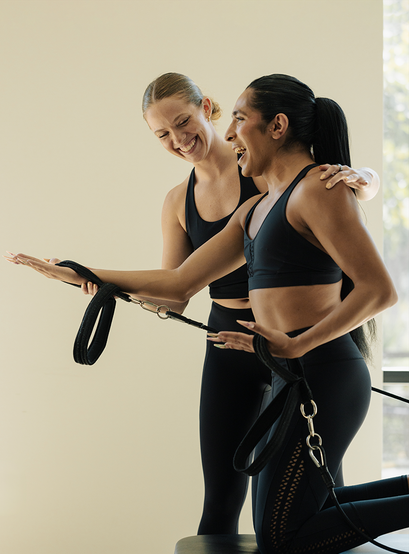
Pilates and Pregnancy: Best Poses and Pregnancy Workouts
Pregnancy brings rapid physical change – but you don’t need to stop moving your body.
It’s normal to question what’s safe to continue doing while you’re expecting – especially when it comes to your exercise routine. Many women search “can you do Pilates when pregnant” because they’re unsure how to keep moving without doing the wrong thing.
The reality, though, is that there are still many ways to move that support both you and your baby – you just need the right guidance!
At FS8, our workouts – which blend a unique mix of Pilates, tone, and yoga – are designed to adapt to you. Our experienced trainers guide how you move and adjust each exercise as your body changes, so you can keep moving with confidence throughout your pregnancy.
Join us as we break down how pregnancy Pilates works, and how to adjust your movement across each trimester. We’ll also cover what to avoid, and how an FS8 trial can help you experience reformer Pilates during pregnancy in a way that feels right for your body.
Can you do Pilates when pregnant?
Yes – you can do Pilates when pregnant, providing you have medical clearance and make any adjustments your doctor recommends to how you train1.
As your body changes during pregnancy, how you move will feel different. Your balance shifts, your abdominal muscles lengthen, and pressure through your core increases2.
But this doesn’t mean you don’t need to stop – just alter your approach.
A pregnancy Pilates workout focuses on slower, controlled exercises and breath to manage pressure through your abdomen and lower back. At the same time, it helps you strengthen your pelvic floor and core as your body grows 3.
Benefits of pregnancy Pilates
Pregnancy Pilates helps you move in a way that supports the physical changes happening through your body.
As your weight shifts forward and your muscles stretch, your body needs more support through your core, hips, and back2. Pilates in pregnancy targets these areas, helping everyday movement feel controlled.
With consistent practice, you can notice:
- Less pressure through your lower back as your bump grows.
- More core muscle strength as your abdominal muscles stretch.
- Better posture as your center of gravity shifts forward.
- Reduced stress levels, helping support your mental health as your body changes.
- Improved circulation, which can help reduce heaviness in your legs4.
- Stronger connection to your breath, which can help during labor5.
Reformer Pilates during pregnancy: what to know
Reformer Pilates during pregnancy can be a safe and effective way to train when you adjust each exercise to your body1.
With reformer Pilates and pregnancy, the focus is not on pushing intensity. It’s about managing load and positioning, which helps to reduce pressure through your abdomen.
This means:
- Changing resistance and range so movements stay controlled and supported.
- Choosing positions that reduce strain, especially as your pregnancy progresses1.
At FS8, our instructors are trained in prenatal Pilates and adjust each exercise in real time based on where you are in your pregnancy.
As FS8 ambassador Cristina Chan explains, “The reformer gives you the flexibility to tailor each movement to your body. By changing resistance and positioning, we can support you through each exercise – so you can keep training safely as your pregnancy progresses.”
Ready to start moving? Sign up for a trial and experience how FS8 adapts every session to your body’s needs.
Pregnancy workouts by trimester
Your energy will shift throughout pregnancy – and your training should shift with it.
A first trimester workout won’t feel the same as your third trimester: so below, we break down how pregnancy Pilates evolves across each stage, helping you understand what to expect and how to adjust.
First trimester workouts
In the early stages of pregnancy, your body is already working harder behind the scenes. Your hormone levels rise, your blood volume increases, and fatigue can hit quickly2. That’s why a first trimester workout should be low impact and feel easy to flow through.
Focus on:
- Keeping intensity low – you should be able to hold a conversation the entire time.
- Using breathing techniques to stay connected to your deep core and pelvic floor3.
- Taking breaks to avoid overheating or fatigue.
To support you through the first trimester, our FS8 Original workouts use controlled, low-impact movement with options to scale up intensity. This allows you to keep moving without pushing beyond what your body can handle.
Second trimester training
In the second trimester, your body starts to change more visibly. As your bump grows, your weight shifts forward – placing more demand on your spine, hips, and supporting muscles2.
As your body adapts to Pilates and pregnancy, ensure that in your workouts, you:
- Avoid lying flat on your back for long periods1.
- Strengthen your glutes and upper back to support posture.
- Slow your tempo to stay controlled and improve your balance.
FS8 Ignite introduces more resistance to build strength in the muscles now taking on more load, particularly your glutes and back, while helping to improve hip mobility. The adjustable spring load lets you scale support or intensity, so you can strengthen without overloading your body.
Third trimester movement
By the third trimester, your body is carrying more load, your abdominal wall is stretched, and stability becomes the priority2.
As you continue with prenatal Pilates, your workouts should be focused on:
- Reducing impact and avoiding fast transitions.
- Using supported positions like seated or side-lying.
- Prioritizing pelvic floor awareness and gentle mobility.
Our ReformX workouts focus on the reformer, using the carriage and springs to support your body through each movement. This helps you stay stable, move with control, and reduce pressure through your abdomen – making it well-suited to later pregnancy.
Pilates and pregnancy: what to avoid
As your body changes, some exercises place too much pressure through your abdomen or become harder to control safely.
Diastasis recti – where the abdominal muscles separate – is a normal part of pregnancy. However, certain movements can increase strain if not adjusted6.
When practicing Pilates in pregnancy, you should avoid:
- Deep spinal flexion under load, which can increase pressure through your abdominal wall.
- Crunches and sit-ups that place direct strain on your midline.
- Long-held planks, which can overload your core.
- Strong twisting movements, which add rotation through your abdomen.
- Unstable balance work, which can reduce control as your center of gravity shifts.
Why guided, small-group classes make a difference during pregnancy
When you’re training during pregnancy, how you move matters more than how much you do.
Our workouts combine Pilates, tone, and yoga-inspired movement. This approach to Pilates maternity training uses slower pacing and breath to help you stay aware of how your body feels as it changes.
In every FS8 class, you can expect:
- Small group setting that allows instructors to focus on you.
- Real-time adjustments that respond to how your body feels.
- A steady pace that allows you to move safely without feeling rushed.
As Cristina Chan adds, “No two pregnancies feel the same, and neither do our bodies. That’s why our classes are small. We watch how you move and adjust things as you go – whether that’s for pregnancy, an injury, or anything else your body needs – so you never feel like you have to figure it out on your own.”
* This content is for informational purposes only and does not constitute medical advice. Always consult your doctor or a qualified healthcare professional before starting, continuing, or modifying any exercise program during pregnancy.
Learn how our classes combine the benefits of yoga for pregnancy with our pregnancy Pilates workouts.
2 https://www.pregnancybirthbaby.org.au/yoga-and-pilates-during-pregnancy
4 https://www.nhs.uk/pregnancy/keeping-well/exercise/
6 https://www.ncbi.nlm.nih.gov/books/NBK582697/