Barre vs Pilates: Which is Right for You?
Pilates has become one of the most popular ways to build strength, mobility, and balance without the intensity of a traditional gym environment.
Barre, another low-impact workout, is often compared with Pilates because they share some similarities in style and results. But the real question isn’t about choosing one over the other – it’s about understanding your fitness goals, behaviors, and preferences so you can find the training approach that best supports your body.
In this guide, we’ll break down the big barre vs Pilates question: exploring where each comes from, how they’re typically practiced, and what they can help you achieve. Along the way, you’ll also see how Pilates – especially when combined with yoga, strength, and functional training in FS8 workouts – can help enhance your mobility, strengthen your body, and improve your flexibility.
What is Pilates?
Pilates is a low-impact form of exercise that focuses on developing core strength, enhancing posture, and boosting flexibility through controlled, precise movements. It is suitable for all fitness levels and can be adapted to support rehabilitation, strength building, or overall body conditioning.
The method was developed in the early 20th century by Joseph Pilates, who designed it to improve alignment, strength, and functional movement. Over time, Pilates has grown into a globally recognized practice, widely used by athletes, dancers, and everyday exercisers alike for its ability to improve coordination, build balanced strength, and tone the body.
There are two main types of Pilates:
- Mat Pilates – performed on a mat using bodyweight exercises and small props like bands or balls.
- Reformer Pilates – performed on a reformer bed that uses springs and pulleys to create resistance and add variety and intensity.
For many people who enjoy barre, Pilates feels like a natural next step. While barre builds muscular endurance through small, repetitive movements, Pilates goes deeper — strengthening the core, supporting joint stability, and enhancing overall mobility. This is why more barre enthusiasts are turning to Pilates: it provides the foundation of control and strength that helps you move better in any workout.
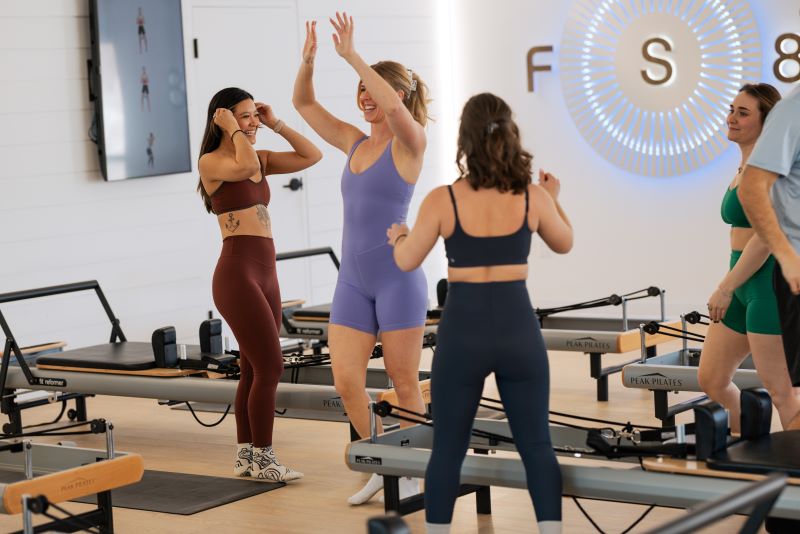
At FS8, our workouts take this a step further. We’ve blended Pilates with strength, cardio, yoga, and tone to create three distinct workout styles: Original, Ignite, and ReformX. Backed by research and science, FS8 makes Pilates the center piece of a more complete training approach designed to keep you strong, balanced, and confident in everyday life. Our workouts combine both mat and reformer Pilates, bringing you the best of both worlds.
What is barre – and why are barre enthusiasts turning to Pilates?
Barre – often performed at a ballet barre (the sturdy horizontal handrail traditionally used in dance training), is focused on small, controlled exercises that build muscular endurance, support hip mobility, and increase flexibility.
Typical classes combine sequences at the barre with mat work, often using light weights, resistance bands, or balls to increase the challenge. Movements are usually small and repetitive, targeting muscles to the point of fatigue – creating that signature “burn” that will leave your muscles sore.
For many people, barre offers an approachable entry point into low-impact training. But over time, enthusiasts often look for something that not only sculpts muscles, but also strengthens deeper stabilizing systems, improves posture, and supports long-term mobility. That’s where Pilates comes in and the perfect mix of exactly what you’re looking for FS8. By focusing on core stability, alignment, and full-body strength, Pilates adds depth and progression to the foundation barre provides.
At FS8, we see Pilates as the base that unlocks this next level of training. Our classes integrate Pilates principles with tone and yoga – helping you move beyond the barre burn to build lasting strength, flexibility, and resilience.
Barre vs Pilates: what’s the difference?
Although barre and Pilates share common ground as low-impact workouts, they differ in origins, class flow, and the way they train your body.
Here’s how they compare, and how Pilates can build on what barre enthusiasts already love:
Equipment
- Barre: ballet barre, light weights, resistance bands, or bodyweight.
- Pilates: mats or reformer beds with springs and pulleys, plus small props for added challenge.
- Progression: Pilates equipment introduces resistance and variety, helping you go beyond endurance to build balanced strength.
Focus
- Barre: muscular endurance, sculpting, balance, and flexibility.
- Pilates: core strength, posture, alignment, controlled movement.
- Progression: Pilates adds a focus on stability and mobility that supports better performance in barre or any other workout.
Muscle groups targeted
- Barre: smaller muscle groups (glutes, thighs, arms) for definition.
- Pilates: deep stabilizing muscles (core, spine, pelvic floor) for full-body strength.
- Progression: Pilates strengthens the foundation that makes barre movements (and everyday activities) safer and more effective.
Intensity
- Barre: higher reps, cardio-style sequences, upbeat energy.
- Pilates: slower, precise, controlled pace.
- Progression: Pilates complements barre’s burn with deeper control – giving your body balance between endurance and stability.
Class flow
- Barre: flowing, repetitive sequences to create muscular fatigue.
- Pilates: structured exercises centered on breath and precision.
- Progression: Pilates teaches body awareness and control that translates back into better barre performance (and beyond).
Suitability during pregnancy
- Pilates: often recommended (with modifications) because of its focus on core stability, posture, and breathwork. Pre-natal Pilates classes are widely available, and exercises can be adapted to support pelvic floor strength and reduce discomfort.
- Barre: may also be suitable during pregnancy, although some movements (like lying on your back for extended periods, or deep pliés) may need to be modified.
To learn more about exercising while you’re expecting, explore our guide to the benefits of yoga during pregnancy. Always consult a healthcare professional before starting or modifying your exercise routine during pregnancy.
Barre vs Pilates: which is better for your goals?
The barre vs Pilates debate isn’t about which form of exercise is ‘better’ – only what’s better for you, and the fitness targets you want to hit.
While barre may offer an entry point into low-impact training, Pilates provides the deeper foundation that helps you progress and stay strong long term. A reminder that FS8 isn’t only Pilates, it’s Pilates, tone and yoga. Bringing you a unique combination of different modalities to achieve your strongest self.
Core strength and stability
- Barre: challenges balance and posture through small, controlled movements.
- Pilates: directly targets deep core muscles and stabilizing systems.
- Takeaway: Pilates builds the foundation of strength that enhances barre and other workouts.
Toning and sculpting
- Barre: high-rep, isometric movements that fatigue muscles for definition.
- Pilates: lengthens and strengthens muscles, creating balanced tone.
- Takeaway: Barre gives you the burn, while Pilates ensures strength is evenly developed across your body.
Flexibility and balance
- Barre: dance-inspired stretches and sequences that promote mobility.
- Pilates: posture-based alignment and breathwork that improve control and flexibility.
- Takeaway: Both support flexibility – Pilates adds long-term mobility benefits.
Sustainable training and injury prevention
- Barre: a fun, energetic workout that builds endurance.
- Pilates: widely recommended for rehabilitation, functional strength, and safe progression.
- Takeaway: If you want a workout that evolves with you at every stage of life, Pilates is the stronger foundation.
Barre vs Pilates: can you do both?
Absolutely – and combining barre and Pilates can be highly effective. Barre gives you the endurance and energy of high-rep sequences, while Pilates builds the deeper strength and control that supports long-term mobility. Together, they create a routine that balances stability, flexibility, and stamina.
But the truth is, you don’t need to juggle multiple studios or memberships to experience this mix. At FS8, we’ve designed our workouts to give you the best of both worlds – and more. Pilates is at the core of every FS8 class, but it’s combined with functional strength, cardio, yoga, and tone. That means you get the sculpting endurance barre enthusiasts love, while also building the foundation of strength and control that only Pilates can provide.
This integrated approach reflects what FS8 stands for: functional movement (FS) and eight key elements of training (8), all in one. The result? A workout that challenges your muscles, improves your posture, boosts your confidence, and fits seamlessly into your lifestyle.
Now that you’ve read about the barre vs Pilates distinction, the real takeaway is clear: Pilates lays the foundation for strength, balance, and mobility that lasts. To learn more, explore how Pilates can work with – rather than against – your fitness routine with our guide to balancing Pilates vs gym.