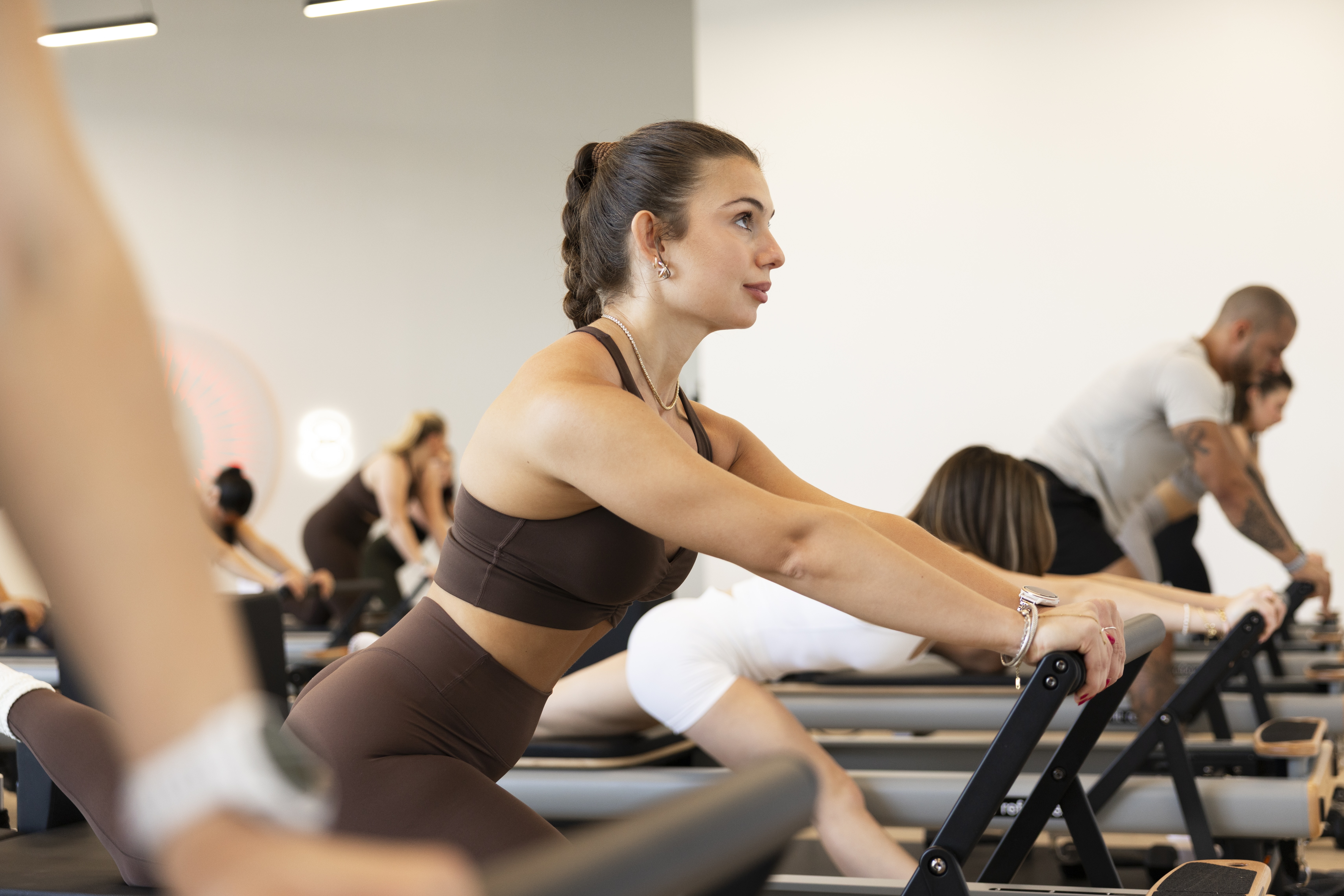
What is Proprioception and Why is it Important in Pilates?
You often hear about Pilates improving posture, building strength, or helping you move with more control. But one of its most valuable benefits is something you may not have heard of: proprioception.
So, what is proprioception?
It is your body’s internal sense of where it is in space. It’s what enables you to place one foot in front of the other without looking down or catch your balance before you fall – and what your brain relies on to move with control.
Join us as we explain what proprioception is, why it is so important, and how FS8 workouts blend Pilates, tone, and yoga to help you improve your balance and proprioception.
What is proprioception?
Proprioception is your body’s internal sense of its position and movement1. It allows your brain to track where each part of your body is, even when you cannot see it.
Close your eyes and touch your nose. You found it without looking, right? That’s proprioception – your internal sense of position, working behind every movement you make.
How does the proprioception system work?
Your proprioception system runs on a constant feedback loop.
It starts with tiny receptors in your muscles, tendons, and joints1. They measure how far a muscle is stretching, how much load you’re holding, and the angle of a joint as it bends.
These receptors feed those signals up through your nervous system to your brain1. Your brain reads the feedback, coordinates your balance, posture, and control, then sends instructions straight back to your muscles¹.
Most of this happens without you noticing. The movements you find in Pilates slow your body down enough to notice your alignment, balance, and weight shift – and the more you tune into those signals, the sharper your proprioception becomes².
6 benefits of proprioceptive awareness
Proprioception is often called the “sixth sense” – it reads your body’s motion and position with no conscious thought at all1. The sharper it gets, the more you notice it in the way you move. Read on for six benefits you’ll notice when developing proprioception.
1. Improves your balance
When you stand on one leg, start to wobble, then steady yourself before your foot touches down – that’s balance and proprioception in action. This is how yoga and Pilates improve your balance: slow, held shapes like tree pose or a controlled lunge keep you working at the edge of stability – and train the deep stabilizing muscles that make those corrections for you.
2. Gives you greater control over your body
Think about carrying an armful of shopping and nudging the door shut with your hip or climbing the stairs without once looking down at your feet – you’re placing your body precisely without watching it happen. That’s your proprioception awareness giving you control. In Pilates, proprioception helps you notice when your knee is drifting inward or your back is lifting away from the mat. Feeling these changes as they happen allows you to correct your position in the moment, making each movement more precise and controlled.
3. Trains your coordination
Remember trying to pat your head and rub your belly at the same time? At first, your brain can only manage one, but with a few tries it starts to click – proof that you can train your coordination. Proprioception is a big part of why: once your body knows where its limbs are without being told, movements that once took total concentration start running on their own.
4. Helps prevent injury
If your foot lands awkwardly on an uneven path, sensory information from your muscles and joints triggers a response before you’ve even consciously registered the stumble. The muscles around the joint fire to steady you and stop a small misstep from becoming a fall.
This is a particularly valuable benefit of Pilates for over-60s, as proprioception naturally dulls with age3 – and the reflexes that catch you slow down. Practicing Pilates keeps that protective response sharp, so your body is quicker to correct itself when thrown off-balance4.
5. Supports good posture and alignment
Good posture isn’t just about remembering to sit up straight – strength and posture work together, and both are guided by your body’s awareness of where it is. Your brain needs to sense how your head, spine, and pelvis are positioned so it can keep them organized as you move, while the muscles around them do the work of holding that position. Better proprioceptive awareness helps you notice when you are leaning into one hip or letting your shoulders round forward, giving you the chance to correct it before it becomes a habit.
6. Advances your athletic ability
The faster or more complex a movement becomes, the less time you have to rely on sight. Proprioception helps you adjust mid-movement, control a landing, and repeat practiced patterns instinctively. At FS8, our classes blend traditional Pilates control with athletic training, so you build that fast, reactive awareness while the work stays low-impact.
Examples of proprioception in Pilates and movement
When developing proprioception, the most effective exercises are the ones that make your body work harder to sense where it is in space. Narrowing your base of support, adding instability, or moving without relying on sight all strengthen the communication between your brain, muscles, and joints.
Some examples from our workouts here at FS8 include:
- Single-Leg Stretch: Lie on your back and draw one knee toward your chest while the other leg extends out, then switch sides. Constantly swapping legs builds your core strength to keep you steady.
- Swimming: Lie face down and lift your opposite arm and leg together in a quick fluttering rhythm. The cross-body pattern, done where you can’t see your limbs, sharpens your body awareness.
- Single-Leg Balance: Stand and hold your weight on one leg. This wakes up the small stabilizing muscles around your ankle, knee, and hip that tell your brain where you are.
- Teaser: Balance on your sit bones with your legs and torso lifted into a V-shape. Holding it takes constant tiny adjustments to find your center.
- Roll-Up: Peel your spine off the mat one bone at a time, then lower back down the same way. It builds a feel for moving your back in segments rather than all at once.
- Mermaid: Sit to one side and reach your arm up and over in a long side stretch. The twist trains your sense of how your body is oriented when you rotate.
- Reformer Footwork: Push the moving carriage out and control it back in. Because the carriage slides, every rep needs small corrections to stay smooth.
Want to feel it for yourself? Find your closest FS8 studio, start a trial, and start training your proprioceptive awareness today!
How to develop proprioception through Pilates: 5 tips
What Pilates does for your proprioception is strengthen the connection between your brain and body – so you can sense your position more clearly and react faster in an FS8 class.
Read on for five practical ways to use Pilates to sharpen that awareness and move with more confidence.
1. Slow the movement down
Next time you’re moving through a Pilates exercise, resist the urge to rush it – take the pace right off and let each rep unfold slowly. The slower you go, the more time your brain has to register where your body is, and that’s exactly what strengthens your proprioceptive awareness. Let the Pilates Reformer help you: its sliding, spring-loaded carriage will get away from you if you rush it, so it naturally pulls you back to slow, deliberate control.
As FS8 trainer Cristina Chan puts it: “There’s a reason we’re always telling you to slow down, drop your shoulders, and engage your core. When you slow right down, you have to actually feel where your body is – and the moment you can feel it, you can control it. That’s what makes a difference on the reformer, and it carries over to everything you do off it.”
2. Build strength to sharpen the signal
Resistance training transforms your body, and part of that change happens in the sensory receptors responsible for muscle proprioception5. Located within your muscles and tendons, these receptors detect stretch, tension, and length, then send that information to your brain so it can track each joint’s position. As the surrounding tissue grows stronger, these signals can remain clearer as fatigue sets in, helping you maintain control throughout your workout.
Our 30-Day Strength Program is an easy way to build resistance training into your routine. This structured challenge uses adjustable spring resistance and trainer guidance to meet you where you are. As you get stronger over the 30 days, you also build the control to sense your position and adjust when a movement gets harder.
3. Add balance challenges gradually
Balance work is one of the fastest ways to build proprioception, because reducing your base of support forces your stabilizing muscles to keep you steady5. Single-leg work, kneeling sequences, and standing movements all raise the demand, and Pilates props like a ball or the box can add another layer once you’re ready. The key is progressing gradually – we build these challenges in at a pace that meets you where you are.
4. Use breath as an anchor
Instead of watching yourself in the mirror, use breathing techniques to feel your way through each movement. Try diaphragmatic breathing – breathing deeply into your belly rather than shallowly into your chest, so your ribcage expands and your core stays switched on.
Once you’ve got the rhythm, let it guide the effort:
- Inhale to prepare as you lengthen or lower into the movement.
- Exhale on the effort as you contract, lift, or push through the hardest part.
5. Train with instructor guidance
Some alignment issues – such as a dropped hip or collapsed arch – are hard to spot on your own. A trained instructor can see what you may not yet feel and offer a cue that sharpens your body proprioception until the movement clicks. As Cristina Chan explains, “You can’t always feel what your body is doing, but I can see it. One small cue can make all the difference, especially for Pilates beginners who are still building good movement habits.”
In every FS8 session, you get that expert attention on your form, plus all the benefits of group exercise – so your awareness builds faster than it would training alone.
The body awareness proprioception gives you is just one more benefit of reformer Pilates – next, learn how Pilates can reboot your mental health too.
Sources:
1 https://pubmed.ncbi.nlm.nih.gov/23073629/
2 https://pubmed.ncbi.nlm.nih.gov/38063651/
3 https://pubmed.ncbi.nlm.nih.gov/37444758/
4 https://pubmed.ncbi.nlm.nih.gov/24831756/
5 https://pubmed.ncbi.nlm.nih.gov/36188962/