What are Low-Impact Workouts and the Advantages?
It’s a common misconception that a workout only counts if you’ve pushed through it: that last brutal rep, or the sprint that leaves you flat on the floor.
But there are plenty of low-impact exercises that will challenge your muscles just as much – without putting pressure on your body.
So, what is low-impact exercise?
Low-impact means movement that reduces stress on your joints, often by keeping at least one foot or point of contact connected to the ground or equipment.
At FS8, our workouts combine low-impact exercises drawn from Pilates, tone, and yoga-inspired movement to create sessions that stay challenging and dynamic. Read on for what a low-impact workout actually involves, the benefits you can expect, and why it might just be your ideal way to train.
What is low-impact exercise?
Low-impact exercise is gentle movement that minimizes the stress placed on your joints. Think of a slow, weighted lunge instead of a jump squat. The effort is still there – it just builds up in your muscles slowly rather than jarring through your joints1.
Low-impact exercise could be a long walk, a bike ride, or a strength session moving you through controlled squats and shoulder presses. You stay grounded and in control the whole way through, so there’s no crashing back down through your knees, hips, and ankles1.
That’s exactly why Pilates – the foundation of our workouts – is low-impact. Every movement is slow, controlled, and deliberate, with resistance coming from your bodyweight, springs, and bands rather than force.
What is a low-impact workout?
A low-impact workout is a structured session that contains a series of exercises, with each one targeting a different area of the body. One of the key low-impact workout benefits is that the session can be sequenced to activate one muscle group while another recovers – helping you keep moving without burning out1.
Our classes combine Pilates core work, resistance band glute exercises, controlled lunges, yoga-inspired flows, mat-based strength, and mobility-focused stretches, moving from one to the next until you’ve worked head to toe.
Low impact vs low intensity: what’s the difference?
Low-impact exercise and low-intensity exercise are not the same thing:
- Low-impact exercise is about joint stress – how much force is traveling through your body.
- Low-intensity exercise is about effort – how high your heart rate climbs.
The confusion is because a workout can be low-impact and high-intensity at the same time. When you slow a movement down, add resistance, and hold the tension, the effort doesn’t disappear – it sinks deeper into the small stabilizing muscles and builds intensity2.
Examples of low-impact workouts and exercises
Now that we’ve covered what a low-impact workout is, what does it look like in practice? Read on to find out the different kinds of low-impact exercise you’ll experience here at FS8.
Pilates
Pilates is a low-impact, mind-body method built on control, precision, and breath2. Traditional mat-based Pilates is slow and deliberate, which is exactly what makes it so effective at building core muscles, improving posture, and toning your body.
Our FS8 Original workouts draw on those traditional Pilates fundamentals and fuse them with contemporary movement. We keep the focus on slow, controlled, low-impact exercise that keeps your mind and body connected – whether you’re learning the basics, or continuing to master your form.
Reformer Pilates
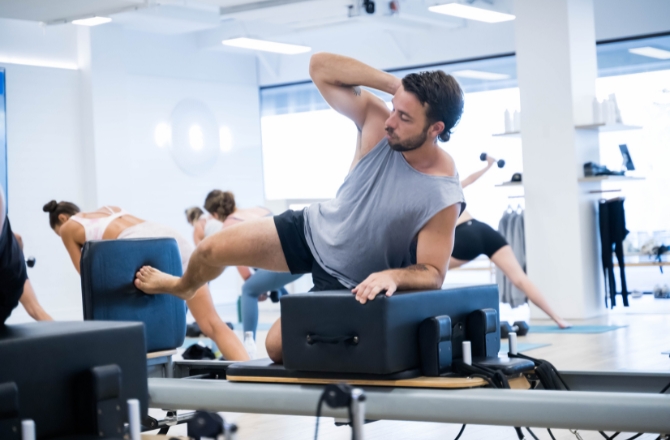
A Reformer Pilates workout brings the controlled movements of Pilates onto the reformer – a sliding carriage loaded with adjustable springs. Because the carriage glides on rails and the springs both guide and resist each rep, exercises like footwork, leg presses, and kneeling planks are able to feel challenging – without sending impact through your joints.
Our ReformX workouts focus exclusively on the reformer bed: blending modern, dynamic movement with a spring load to match the strength or control you’re working toward.
Yoga-inspired flows
Yoga-inspired flows move through sustained holds, slow controlled transitions, and mindful meditation. Because you stay grounded and move under your own body weight, each flow builds mobility and improves flexibility, balance, and breath control.
Resistance band exercises
Resistance bands load your muscles through elastic tension, rather than heavy weight. The resistance builds smoothly as you stretch the band and eases as you release, so there is no load crashing through your joints.
We use resistance bands frequently in FS8 Ignite Workouts in moves like bridges, lateral walks, and lunges – they are built for firing up the glutes, hips, shoulders, and core.
Controlled strength exercises
Strength training can be a low-impact exercise when each movement is performed slowly and with control. Instead of relying on momentum to move the weight, you keep the muscles under steady tension throughout the rep – which is why low-impact fitness often uses lighter loads. A lighter weight is one you can control for longer, so the muscle stays working through the full range of the movement2.
Reformer Pilates is a form of resistance training that uses springs to challenge the muscles. Our 30-Day Strength Program builds on that with a personalized, structured challenge designed to help you build strength while staying consistent with your goals.
Walking or incline walking
Walking is low-impact cardio at its most accessible, and an incline lifts the effort without lifting the impact. Your foot stays in contact with the ground with every step, so you raise your heart rate without the landing force that exercise like running drives through your body.
Cycling or swimming
Cycling and swimming let you work hard while your joints stay supported. On the bike, your feet stay fixed to the pedals, and the saddle carries your weight. In the pool, buoyancy removes the impact altogether, so you’re working against the water – not against the ground!
What are the benefits of low-impact workouts?
Turns out, going easy on your joints doesn’t mean going easy on the results. Below, we break down the top seven low-impact workout benefits that our members notice most.
1. They are kinder to your joints
Low-impact fitness keeps the repeated loading through your ankles, knees, hips, and spine low, letting you raise your heart rate and work your muscles while your joints stay protected1. That means you can move consistently without unnecessary joint stress – which is especially valuable if you’re recovering from an injury, moving through pregnancy, or practicing Pilates when you are over 60.
2. They can still build strength
Low-impact exercise does not mean low effort – and you don’t need heavy weights to build muscle. Resistance bands, springs, holds, and pulses all give your muscles something to work against – and muscles grow precisely by working against such resistance3.
In a recent study, participants trained one leg with heavy weights and the other with light ones. Both legs grew the same amount3. So remember: what builds muscle is not the size of the load but working it close to fatigue.
3. They support balance and stability
Many low-impact exercises rely on slow, controlled movements or holding a steady position, both of which ask your body to stabilize itself rather than rely on momentum1. That draws on proprioception – your sense of where your limbs are in space – and the more you train it, the more that awareness carries into daily life, especially during tasks that involve carrying, reaching, or lifting.
4. They can improve mobility and flexibility
You can improve flexibility and mobility when your joints regularly move through their full range of motion. The benefit of low-impact exercises like Pilates and yoga is that they can guide your body slowly and deliberately through that range while the muscles stay active – gently working areas that tend to tighten up, like hip mobility and stiff shoulders1.
5. They may help reduce injury risk
High-impact workouts place more force through the body, which can be challenging for beginners or anyone returning to exercise after an injury1. Low-impact exercise reduces that force while still helping you build strength, mobility, and control. That said, correct form and breathing remain important, which is why every FS8 class is led by a trained Pilates instructor who can demonstrate correct technique and offer modifications, so you can train safely and confidently.
6. They support consistency
The best workout is the one you keep coming back to. Because low-impact exercises feel more sustainable on the body, you’re less likely to be sidelined by sore muscles after a workout – which makes a regular routine far easier to build.
The FS8 app makes it easier still, letting you book classes in a few taps to keep your momentum going. Find your closest studio and download the app to start a trial today!
7. They can support mood and stress relief
Movement is a reliable way to lift your mood, relieve stress, and restore energy4. Pilates and yoga-style movement go a step further, drawing in breath, focus and body awareness so a session becomes a mental reset as much as a physical one. Because low-impact exercise is slow and controlled, it’s easy to flow through a structured routine and keep your attention on your body rather than the outside world.
Who are low-impact workouts suitable for?
Virtually anyone can benefit from incorporating low-impact workouts into their daily life.
With advantages for both physical and mental health, read on to find out how low-impact exercise can bring improvements in balance and strength in a format that works just as well for Pilates beginners as it does for experienced gym-goers.
Beginners
Because there are no heavy loads or fast, high-impact movements to keep up with, you can put your attention where it matters most when you’re starting out: your form and balance.
If it’s your first Pilates class, the only prep you need is to let your FS8 instructor know you’re new – they’ll guide you through the class, so you’re never left guessing!
People returning to exercise
If you are easing back in after time away from movement, low-impact training is a gentle way to rebuild without overwhelming your body. A structured class helps even more, because the format does the thinking for you – all you have to do is show up!
People who want joint-conscious training
Repeated impact through the knees, hips, ankles, and back adds up over time, especially if you have dealt with an injury before. Low-impact workouts let you build strength and stay active while keeping that repetitive load off your joints. And if you do have an injury or something you are mindful of, tell your FS8 instructor – they can adjust the exercises to suit your body.
People who already train regularly
If you’re someone who likes to train five or six times a week, low-impact work makes that kind of frequency sustainable. Because you’re not loading your body with repeated high-impact stress, you can keep showing up, class after class – while still building real strength, mobility, and control.
Anyone who wants a sustainable fitness routine
Low-impact exercise helps you stay motivated to work out, partly because you’re less likely to burn out from fatigue. Plus, group classes like FS8 have a momentum of their own. The energy of the room carries you, and – because you are moving your body in new ways each time – it stays interesting. (Instead of becoming a routine you end up dreading!)
Can low-impact workouts help you get fit?
Absolutely! Low-impact exercise can support a wide range of goals, from building strength and improving mobility to managing weight and lifting your overall fitness. The key thing to understand is that “low-impact” describes the force travelling through your body during exercise – not how hard you’re actually working. You can move gently on your joints and still train at a challenging intensity.
At FS8, we blend science-backed movement with the best of low-impact fitness – Pilates, tone, and yoga – to help members achieve full-body results that go beyond aesthetics and change the way they move. So, now that we’ve cleared up exactly what low-impact exercise is, the next question is timing. Read our guide to how long it takes to see Pilates results next.
1https://pubmed.ncbi.nlm.nih.gov/26512340/
2 https://pubmed.ncbi.nlm.nih.gov/36431291/
3 https://www.biorxiv.org/content/10.1101/2025.04.28.650925v1
4 https://pmc.ncbi.nlm.nih.gov/articles/PMC4013452/