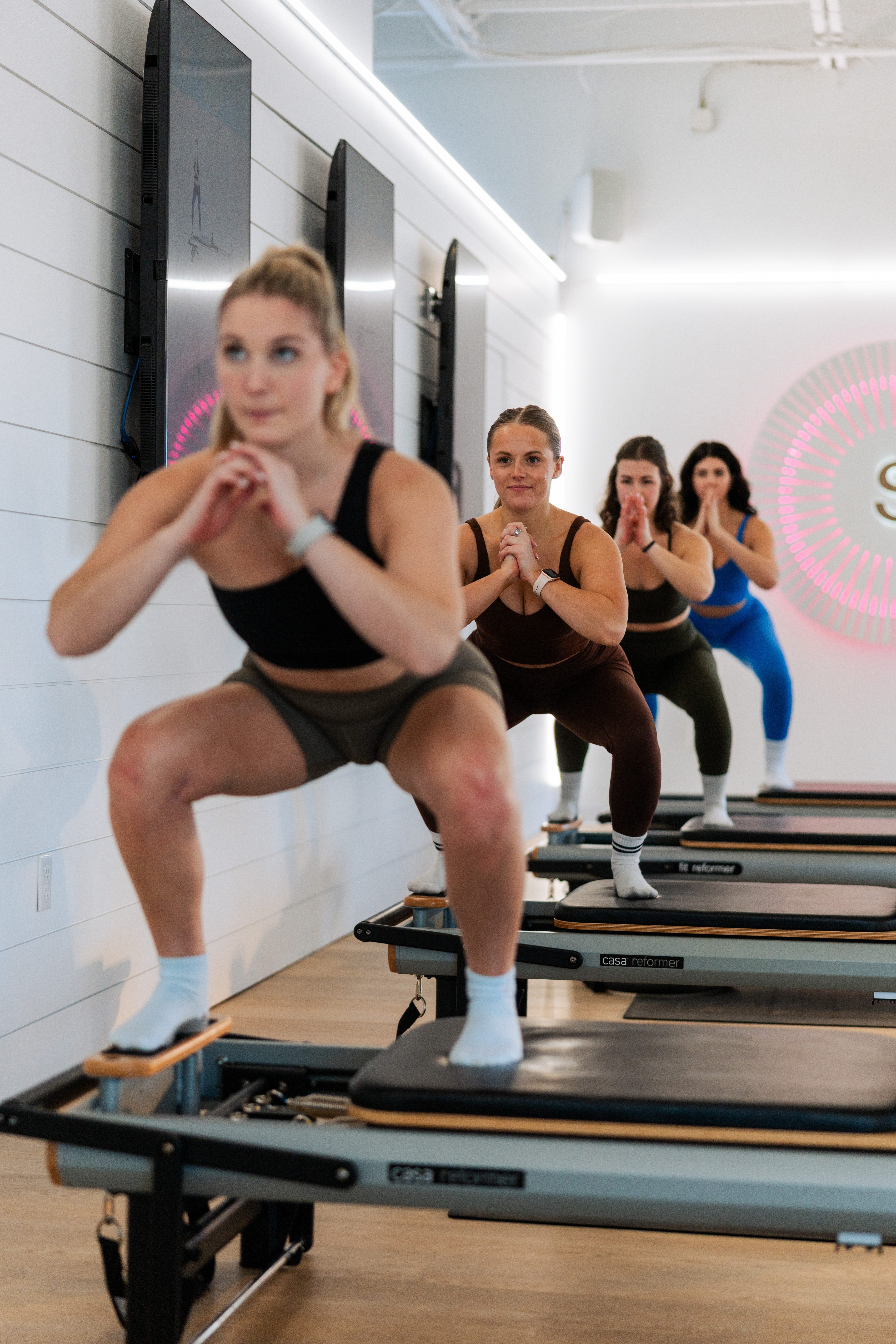
How to Track Your Fitness Progress During the FS8 Strength Program
You’re showing up, putting in the work, and doing everything right – so why does it feel like nothing is changing? Struggling to see tangible Pilates results is one of the most frustrating parts of any fitness journey, and you’re not alone in feeling it.
That’s why the team at FS8 designed our 30-Day Strength Program to make progress impossible to miss. By setting clear goals from the start and checking in week by week, you’ll learn to spot the small improvements, and use them to motivate you as you build strength.
So, what is the 30-Day Strength Program, and how can you get involved? Below, we’re breaking down how to know your workout is working – from fitness progress tracking to the numbers that actually matter – so you can stay focused on your long-term goals.
Why tracking your fitness progress matters
Tracking workout progress gives you clear proof that your hard work is paying off.
Have you ever heard the phrase “the body achieves what the mind believes”?
Research on self-monitoring backs this up: people who log their progress are significantly more likely to stay consistent, because visible proof of improvement is what sustains motivation when it’s needed most1. This is the reason our 30-Day Strength Program is built around clear milestones – to make every small win impossible to ignore.
What is the FS8 Strength Program?
Our 30-Day Strength Program is an attendance-based challenge where you set your own goal, build consistency, and track how your strength develops across the month.
As FS8 trainer and athlete Cristina Chan explains, “The 30-Day Strength Program was designed by a team of expert athletes to bring people back to the foundations of Pilates. Once you learn how to move with control, you can get so much more out of every exercise.”
During the program, you’ll focus on:
- Building spinal strength so you can stand taller and move with better posture throughout your day.
- Activating your deep core muscles to keep your pelvis stable – the foundation every other movement relies on.
- Improving flexibility through your back body so you feel less tight and more at ease in your body.
- Developing hip mobility through slow, controlled movements that train your joints to move freely without compensating.
- Strengthening your hamstrings and glutes so every step, squat, and lift feels powerful and supported.
How to track your progress using the FS8 app: 5 strategies for success
To help you experience the full benefits of Pilates, we created the FS8 app – your all-in-one tool for booking classes, tracking calories, and accessing expert fitness advice and recipes.
And now, that app is even more useful. Read on to discover how to track your fitness progress within the FS8 app as you work your way through our 30-Day Strength program.
1. Set yourself a SMART goal
Before your first Pilates class, you’ll set a goal – and not just any goal. We’re talking about a SMART goal: one that is specific, measurable, achievable, relevant, and time-bound.
Rather than something vague like “I want to go to more Pilates classes,” a SMART goal sounds more like “I will attend three FS8 classes per week for eight weeks to build core strength and improve my posture”. The more specific your goal, the easier it is to track – and the more satisfying it is to achieve!
2. Link Apple Health for deeper insights
The FS8 app connects with Apple Health to give you a centralized, real-time overview of your fitness progress tracking. Once linked, your FS8 workout details – like duration and calories burned – are automatically tracked and combined with your broader health metrics. This gives you an overall performance score and helps you identify patterns over time.
Already using another fitness tracker? No problem. You can also manually log your metrics directly in the app to keep all your progress in one place.
3. Track attendance and consistency
Showing up is one of the most powerful things you can do for your progress. Attendance is a key success metric in the FS8 app because consistency is what builds lasting habits – and lasting results. Plus, what you need to remember is that consistency is ultimately a personal commitment – but it’s also a skill. Understanding what keeps you motivated (and, conversely, what makes you talk yourself out of showing up) is half the battle.
With our “choose your own adventure” attendance model, you’re in control of how much you want to challenge yourself. That could be:
- Blue Spring: three classes a week
- Yellow Spring: four classes a week
Ready to get started? Check out the schedule of your local FS8 studio to start your trial, book a class, and find out when the next Strength Program is kicking off near you.
4. Attend weekly check-ins
Over 30 days, you’ll complete five weekly check-ins where you rate both your wellness and performance out of five.
Wellness is your weekly check-in on mood, stress, and general energy. While biometric data gives you a useful baseline, your wellness score captures what wearables can miss – how you actually feel. Your wellness score adds context to the numbers, so your progress reflects both your physical output as well as how your body is coping week to week.
Performance is your self-rated measure of power and technique during class. It adds your own perspective to the data, helping you understand how to measure fitness progress – through the lens of both what you achieved, and how strong you felt doing it.
5. Understanding your FS8 Score
Your FS8 Score brings it all together. By combining your Apple Health data, attendance, and weekly check-ins, it generates a holistic snapshot of how you’re tracking week by week – giving you one clear, meaningful number to reflect your overall progress.
“Your FS8 Score isn’t about ranking yourself against anyone else,” says FS8 trainer Cristina Chan. “It’s a personal benchmark – a tool to help you stay honest with yourself, celebrate progress, and keep showing up.”
Tracking workout progress throughout our 30-Day Strength Program helps you notice the changes being made week by week. Next, dive deeper into what drives these results from a physiological level, with our guide to the science behind Pilates and weight loss.
1 https://pmc.ncbi.nlm.nih.gov/articles/PMC7490310/